How Rear-Side Light Capture Changes the Yield Math for Ground-Mounted Solar Farms
A ground-mounted array sees a different world than a rooftop system. The panel is elevated above open ground, tilted at a fixed or tracked angle, and surrounded by a reflective surface instead of shingles or membrane packed tight against a roof deck. That geometry is exactly what a dual-glass bifacial module is built to exploit, since the rear side of the cell can absorb photons reflected off soil, gravel, concrete, or a white geomembrane rather than letting that light go to waste.
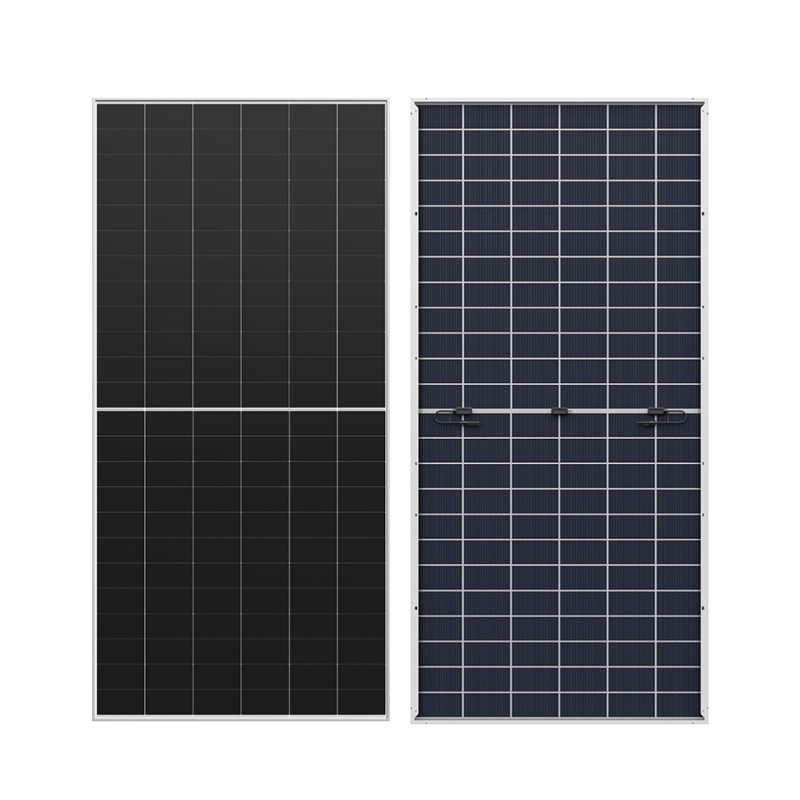
For utility-scale developers, the practical question is rarely whether bifacial technology works. It is how much additional energy a specific site, mounting height, and ground surface will actually deliver, and whether that gain changes the economics of the interconnection, the racking bill of materials, and the long-term revenue model enough to matter. This guide works through that math using concrete figures rather than marketing language, covering albedo, mounting height, degradation behavior, and total cost of ownership for a LONGi Hi-MO X10 640-670W bifacial solar panel supplier evaluation process.
A useful way to frame the decision is to treat the module as one variable inside a larger system rather than the whole answer. Row spacing, tracker versus fixed-tilt racking, inverter string sizing, and the ground treatment budget all interact with the module's bifaciality factor to produce the plant's actual annual energy output. Skipping any one of those variables during early feasibility work tends to show up later as a gap between the modeled production guarantee and the metered result, which is exactly the gap a careful pre-construction review is meant to close.
640-670WPower class
Up to 30%Bifaciality factor
2 glassDual encapsulation
01
Why Ground Surface Reflectivity Decides Your Real Bifacial Gain
Bifacial gain is not a fixed number printed on a datasheet. It is a function of albedo, the fraction of incoming sunlight a surface reflects back upward. A dark asphalt lot and a bed of white crushed stone underneath the same rack will not produce the same rear-side output, even with identical modules and identical tilt angles.
Developers frequently underestimate this variable during early-stage yield modeling, then discover during commissioning that actual rear irradiance sits well below the assumption baked into the financial model. Matching ground treatment to the site's soil type, and budgeting for a reflective ground cover where the native surface is dark, is one of the highest-leverage decisions in a ground-mount design package.
These figures represent typical rear-side yield addition over an equivalent monofacial module at the same tilt and height, not the total plant output. Notice that the jump from bare soil to a purpose-installed reflective ground cover is often larger than the jump from one module generation to the next, which is why ground treatment specifications belong in the same design review as the module datasheet.
Seasonal variation also plays a role that a single annual average tends to hide. Snow-covered ground during winter months can temporarily push rear-side gain well above the numbers a summer-only site visit would suggest, while a vegetated field that stays green through the growing season will trend toward the lower end of the range. Where the budget allows, a low-cost light-colored aggregate or geotextile ground cover under and between the rows is one of the more cost-effective upgrades available on a ground-mount project, since it raises the albedo baseline for the full operating life of the plant rather than only during specific weeks of the year.
02
Mounting Height and Tilt: Getting the Geometry Right Before Racking Is Ordered
Rear irradiance falls off sharply near the ground because the module blocks its own reflected light at low clearance. Raising the bottom edge of the array increases the sky view factor on the rear glass, but returns diminish past a certain point, and every extra centimeter of post height adds steel and installation labor across a multi-megawatt field.
Row spacing and tilt angle interact with height in the same way. A steeper tilt on a fixed-tilt ground-mount system opens more rear-side view to the ground between rows, while tighter row spacing reduces it. Most utility-scale designs converge on a clearance range that balances incremental gain against the added cost of taller racking, rather than chasing the theoretical maximum.
The curve flattens noticeably beyond roughly 1.5 meters of clearance. For most fixed-tilt utility projects, this is the point where an engineering team should stop optimizing for rear irradiance alone and start weighing the marginal gain against steel cost, wind loading, and foundation depth.
Single-axis tracking systems change this calculation again, since the module's orientation relative to the sun shifts throughout the day and the rear face spends part of the afternoon facing a different section of ground than it did in the morning. Trackers paired with bifacial modules generally report a larger overall gain than fixed-tilt bifacial arrays at the same site, but they also carry additional mechanical complexity and a higher upfront racking cost that needs to be weighed against the incremental energy revenue over the contract term.
03
Peak Sun Hours: Sizing a Ground-Mounted Array Without Guessing
Peak sun hours describe the number of hours per day during which solar irradiance would need to hold steady at a reference level to deliver the same total energy as the actual, variable irradiance a site receives. It is the single most useful number for sanity-checking an energy yield estimate before a full simulation is run.
A simplified sizing check works like this: take the site's average daily peak sun hours, multiply by the module's rated wattage, then apply a system derate factor that accounts for inverter efficiency, soiling, wiring losses, and temperature effects. For a bifacial module, the rear-side contribution is layered on top of that front-side estimate once the ground albedo and clearance factors from the previous sections are known.
Site Peak Sun Hours
Front-Side Only Daily Output
With 15% Bifacial Gain
4.0 hours
2.56 kWh per panel
2.94 kWh per panel
5.0 hours
3.20 kWh per panel
3.68 kWh per panel
6.0 hours
3.84 kWh per panel
4.42 kWh per panel
Across a plant with tens of thousands of modules, the difference between the front-only column and the bifacial column stops being a rounding error and starts showing up directly in the annual production guarantee. This is why an accurate albedo and clearance assumption during pre-construction modeling matters as much as the module's front-side efficiency rating.
It is worth running this calculation with a conservative and an optimistic albedo assumption side by side rather than a single point estimate, since ground conditions at a greenfield site often change during construction. Grading, drainage work, and vegetation control can all shift the surface reflectivity away from the value used in the original site survey, and a sizing model that only carries one number forward into the financial close has less room to absorb that kind of drift.
04
Dual-Glass Construction: What Changes When Both Sides Collect Light
Building a module that performs on both faces changes more than the electrical layout. The rear sheet moves from a polymer backsheet to a second pane of tempered glass, which improves resistance to moisture ingress, potential-induced degradation, and UV exposure over a multi-decade service life. That extra layer of protection is part of why dual-glass bifacial modules commonly carry longer product and performance warranty terms than standard monofacial designs.
The frame and junction box design also has to account for the added weight of the second glass pane and for keeping the rear surface as unobstructed as possible, since any shading element on the back, from a frame rail to a mounting clamp placed carelessly, directly subtracts from the rear-side harvest the whole design exists to capture.
Tempered front and rear glass reduces microcrack propagation compared with glass-backsheet construction
Sealed dual-glass lamination lowers long-term moisture ingress at cell edges
Frameless or thin-frame designs minimize rear-side shading from the module's own structure
Higher mechanical load rating supports snow and wind zones without derating the array
Handling procedures during installation deserve equal attention, since a dual-glass module is heavier than a comparable glass-backsheet panel and requires the crew to follow the manufacturer's specified lifting points and torque values on the mounting clamps. Over-torquing a clamp on tempered glass is a common source of avoidable field damage, and it is a risk that is entirely preventable with a short toolbox talk before a new crew's first day on site.
05
Cumulative Energy Yield Over a 25-Year Ownership Period
First-year degradation and the annual linear decline rate that follows both compound over the life of a power purchase agreement or lease. A module with a lower first-year loss and a flatter annual decline curve does not just start higher, it also stays higher for longer, and the gap between two degradation profiles widens every year rather than staying fixed at the number printed on the datasheet's first line.
Over a full 25-year contract, the widening gap between a standard linear decline curve and a slower bifacial decline curve does not stay fixed at the first-year figure. It grows year over year, which is a critical variable for financial modeling on power purchase agreements and lease structures where revenue is tied directly to metered output rather than nameplate capacity.
06
Attribute Comparison: Where Bifacial Dual-Glass Modules Gain the Most Ground
No single specification tells the full story of a module's fit for a ground-mounted project. The chart below lays out five attributes side by side so a design team can see where the tradeoffs actually sit rather than relying on one headline efficiency number.
The rear-side yield and degradation resistance axes are where the shape of the two profiles diverges most. Efficiency and thermal stability differences are meaningful but incremental, while rear-side harvest is a capability the monofacial profile simply does not have, which is why ground-mount projects are where this module class earns back its premium fastest.
07
From Site Assessment to Commissioning: The Ground-Mount Deployment Flow
Getting the rated bifacial gain in the field depends on decisions made well before the first module is unboxed. The sequence below outlines the stages where albedo, clearance, and electrical design choices actually get locked in.
1
Site and Albedo Survey
→
2
Racking and Tilt Design
→
3
Module Installation
→
4
String and Inverter Setup
→
5
Yield Monitoring
Electroluminescence testing after string commissioning is particularly important for high-power bifacial modules, since micro-cracks or cell mismatch on the rear side are not visible to a walking inspection but can measurably affect the fill factor. Buyers sourcing from a LR7-72HVD solar panel distributor should confirm that pre-shipment EL inspection is standard rather than optional on large orders.
08
Ground-Mount vs Rooftop: Comparing Total Cost of Ownership Factors
Return on investment depends on more than the price per watt printed on a quote. Land use, racking design, shading risk, and long-term yield all factor into the final calculation, and they weigh differently depending on whether the array sits on open ground or a building roof.
Factor
Ground-Mounted Deployment
Rooftop Deployment
Available surface area
Large, engineered layout
Fixed by roof geometry
Value of bifacial rear yield
High, ground albedo controllable
Low to moderate, depends on roofing material
Racking and foundation cost
Higher, driven by clearance height
Lower, tied to existing structure
Sensitivity to shading
Low, site chosen for exposure
Moderate, obstructions vary by roof
Impact of slower degradation
Improves PPA and lease revenue
Improves long-term savings
The shared thread across both settings is that a dual-glass bifacial module's economics improve most where the physical constraint is land or roof area rather than budget, and where the operating environment includes a genuinely reflective ground surface. Where those two conditions hold, the higher upfront cost per module is typically recovered well inside the warranty period.
09
What to Evaluate When Sourcing High-Efficiency Bifacial Modules for a Ground-Mount Project
1
Verify bifaciality factor, not just front-side efficiency
The bifaciality factor determines how much of the rear-side irradiance actually converts to power. Ask for third-party verified test data rather than a single number on a marketing sheet, since this figure is what turns ground albedo into measurable output.
2
Confirm degradation warranty structure, not just the headline number
A meaningful performance warranty specifies guaranteed output at multiple points across a 25-year term rather than a single end-of-life figure. That structure gives a much clearer picture of how the decline curve is expected to behave year by year.
3
Ask how load and durability testing is validated before shipment
For a project sourcing high-efficiency bifacial pv modules for sale at utility scale, batch-level mechanical load testing, hot-spot testing, and consistent module-to-module output tolerance matter as much as the headline power class, since large arrays amplify the financial impact of even a small manufacturing inconsistency.
10
Frequently Asked Questions
The questions below cover the details that come up most often once a ground-mount design moves from feasibility study to procurement.
Q1: How much extra energy can a bifacial ground-mount system realistically expect?
Typical rear-side gain ranges from roughly 6 percent over dark asphalt to more than 20 percent over a high-albedo reflective ground cover, depending on mounting height, tilt, and row spacing. A conservative early-stage estimate should use the site's actual ground treatment rather than a best-case industry figure.
Q2: Do dual-glass bifacial modules cost more to install than standard panels?
Per-module cost is generally higher due to the second glass layer, and racking may need a taller clearance to unlock meaningful rear yield. Most utility-scale developers offset this through higher energy output per project acre rather than a lower price per watt.
Q3: Is a bifacial module more fragile than a glass-backsheet panel?
Dual-glass construction is generally more resistant to moisture ingress and UV degradation over time, since both faces are tempered glass rather than a polymer backsheet. Mechanical handling during installation still needs to follow the manufacturer's load and edge-clamping guidance to avoid microcracking on either face.
Q4: Does bifacial gain still matter in humid or low-albedo climates?
Gain is smaller in humid, low-albedo environments where ground surfaces stay dark and wet, but it rarely drops to zero. Pairing the array with a reflective ground treatment, even in a challenging climate, can recover a meaningful share of the rear-side potential.
Q5: How should peak sun hours factor into a ground-mount sizing decision?
Peak sun hours set the front-side energy baseline for the site. Once that baseline is established, the expected bifacial gain from the ground surface and clearance height is layered on top to produce a more accurate total daily and annual output projection.
 English
 Français
 Español
 عربى
عربى Український