Why Back Contact Cell Architecture Changes the Efficiency Math on Commercial Roofs
Every conventional crystalline silicon cell loses a measurable share of its theoretical output before electricity ever reaches an inverter. The culprit sits in plain sight on the front glass: metal grid lines and busbars that collect current but also block a portion of incoming sunlight. Back contact design removes that obstruction entirely by relocating every electrical contact to the rear of the cell, leaving the front surface fully open to light capture.
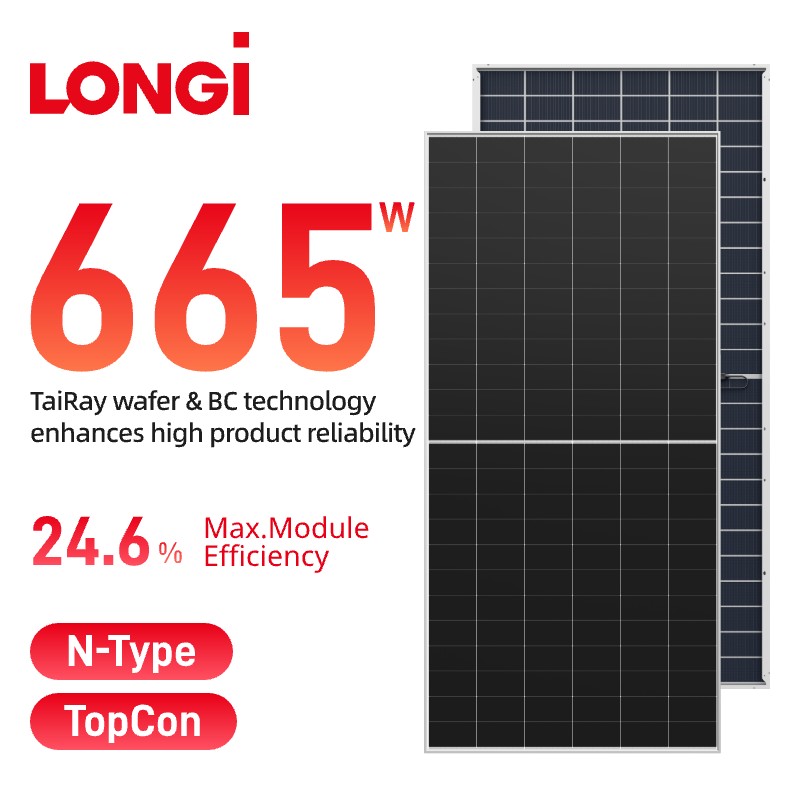
For a LONGi Hi-MO X10 640-670W solar panel, this rear-contact layout is combined with an N-type silicon base, which offers longer minority carrier lifetime and lower sensitivity to common impurities compared with P-type wafers. The result is a module that starts from a higher efficiency ceiling before any downstream engineering, such as anti-reflective coating or busbar spacing, is even applied.
LONGi Hi-MO X10
640-670W
24.6% Max Module Efficiency
N-TypeBack Contact
An efficiency improvement of one to two percentage points over TOPCon and PERC alternatives may look small in isolation, but across a fixed roof footprint on a 25 year service life it compounds into a meaningfully larger total energy harvest, particularly on projects where roof space is the binding constraint rather than budget.
For a buyer sourcing panels through a back contact solar module distributor, this gap directly changes how many modules are needed to satisfy a fixed rooftop capacity target, which in turn affects racking cost, labor hours, and cable runs. Removing front-side busbars also reduces the number of solder joints exposed to direct weathering, since interconnection now happens entirely on the rear laminate surface, generally leaving fewer stress concentration points where micro-cracks tend to originate during thermal cycling or routine foot traffic on walkable commercial roofs.
For procurement teams comparing industrial rooftop PV modules against a fixed budget envelope, this efficiency ceiling has a second benefit. Fewer modules per kilowatt means fewer junction boxes, fewer connectors, and fewer potential points of moisture ingress across the array, which can meaningfully reduce long-term operations and maintenance cost even before accounting for the improved energy yield itself.
How Thermal Behavior Under Rooftop Heat Load Affects Real-World Output
Datasheets are written around a 25 degree Celsius reference condition, but commercial and industrial rooftops rarely stay that cool. Dark composite membranes, low-slope built-up roofing, and reflective glare from adjacent equipment routinely push cell temperature well past 55 or even 65 degrees Celsius during peak summer afternoons, which is precisely when electricity demand and grid pricing tend to be highest.
Every silicon cell loses output as temperature rises, but the rate of that loss depends on cell architecture. A back contact design with a favorable temperature coefficient tends to flatten the output curve more effectively than standard front-contact designs, because rear-side passivation reduces the recombination losses that accelerate under heat.
The practical effect shows up most clearly on hot climate installations and dark roofing materials, where a flatter thermal curve means the array keeps delivering closer to its rated capacity precisely during the summer afternoon hours when utility rates and grid strain both tend to peak.
For engineering teams sizing an array against a fixed inverter capacity, this thermal behavior is not a marginal footnote. It changes the assumptions used in energy yield modeling, particularly for rooftops in hot, high-irradiance regions where ambient temperature alone can push module temperature 20 to 30 degrees above the standard test condition for a large part of the operating day. This same thermal margin also has a practical bearing on inverter sizing, since a module family that holds output more consistently as temperature climbs gives system designers a little more headroom in matching DC array capacity to AC inverter rating, reducing peak clipping risk on unusually hot afternoons.
Roofing material choice compounds this effect further. A white or light colored membrane reflects more incident radiation than a dark composite surface, but many existing commercial buildings were not built with solar in mind and already carry darker roofing. In those retrofit scenarios, a module with a flatter thermal derating curve becomes a more direct lever for protecting expected annual yield than any change to the roofing surface itself, since re-roofing a large facility is rarely realistic within a solar project timeline.
What Long-Term Degradation Means for Cumulative Energy Yield Over 25 Years
Annual degradation rate determines how much of a panel's original output survives after two and a half decades of ultraviolet exposure, thermal cycling, and humidity ingress. Two panels with an identical first-year rating can diverge substantially in year twenty if their underlying degradation curves are different.
Lower first-year degradation, combined with a slower linear decline in subsequent years, produces a meaningfully larger area under the energy production curve across the operating life of the system, even when the starting efficiency figure is held constant between two hypothetical designs.
Over a full 25 year ownership or lease term, the widening gap between a standard PERC-style decline curve and a slower-degrading design does not stay fixed at the first-year figure. It grows year over year, which is a critical variable for financial modeling on power purchase agreements and lease structures where revenue is tied directly to metered output.
Buyers comparing wholesale solar panels for sale should ask suppliers for the full guaranteed degradation curve at multiple points across the warranty term, rather than relying solely on the year-one and year-twenty-five endpoints that appear on most summary datasheets. Facility owners financing a system through a power purchase agreement or long-term lease should treat the degradation curve as a contractual input rather than a marketing figure, since a supplier willing to guarantee output at the five, ten, fifteen, and twenty year marks gives asset managers a far more workable basis for revenue forecasting later in the project life.
Visual Uniformity and Structural Advantages for Rooftop Integration
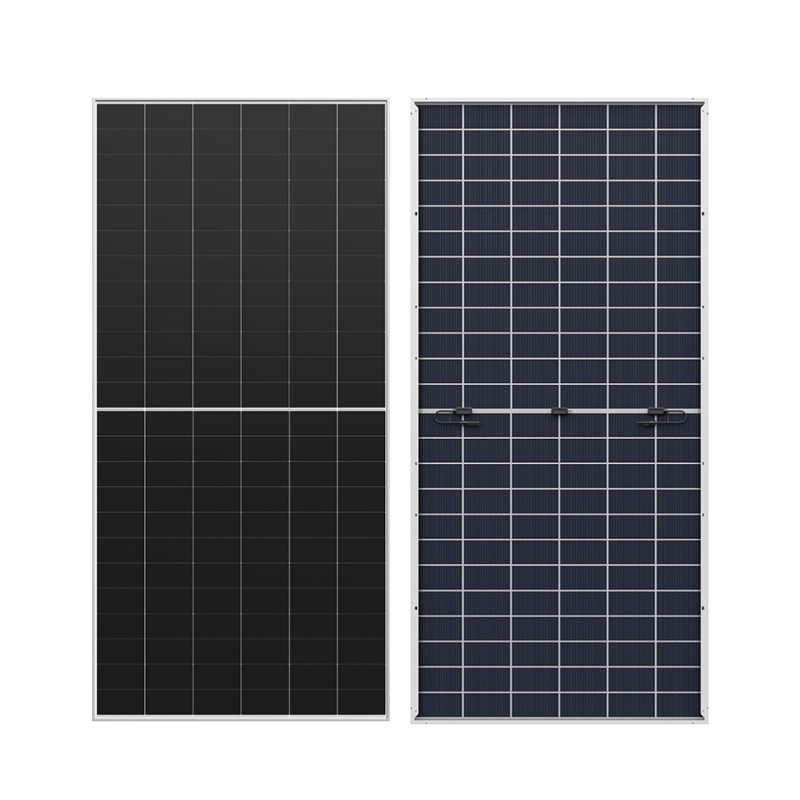
Because the front surface of a back contact module carries no visible busbars or grid lines, the finished panel presents a uniform, low-glare appearance that architects and building owners increasingly specify for street-facing roof planes and highly visible commercial facades.
This is not purely a cosmetic consideration for large commercial and industrial projects. Uniform coloring reduces visible glare inconsistency across large arrays and simplifies visual inspection during routine maintenance, since any hotspot, cell crack, or delamination tends to stand out more clearly against a clean, consistent background than against a grid pattern of busbars and fingers.
For industrial rooftop PV modules deployed across a large membrane roof, this structural advantage extends beyond appearance. Rear-side contacts also tend to reduce the risk of contact-related hotspots forming at busbar solder joints, which is a common long-term failure mode on conventional front-contact panels operating under repeated thermal cycling. Local planning and zoning review boards in many municipalities have also grown more attentive to how visible solar arrays appear from adjacent streets, particularly for retail, office, and mixed-use developments where the roofline is part of the building's overall design language, so a uniform panel surface tends to move through design review more smoothly.
Facility managers responsible for periodic drone or thermal imaging inspections also report a practical benefit from visual consistency. Because the front surface has no repeating busbar pattern to distinguish from an actual defect, automated hotspot detection software tends to generate fewer false positives on back contact arrays, which reduces the manual review time required after each inspection cycle across a large commercial rooftop.
From Wafer to Module: A Simplified Back Contact Manufacturing Flow
Producing a back contact cell requires tighter process control than a standard front-contact line, since both polarity contacts must be precisely aligned on the same rear surface without shorting against each other. The simplified sequence below outlines the core stages of that process at a conceptual level, without reference to any specific production facility.
Electroluminescence testing after contact patterning is particularly important for back contact designs, since micro-shorts between adjacent interdigitated fingers are not visible to the naked eye but can measurably affect fill factor. Suppliers with mature back contact solar panels production lines typically run close to full electroluminescence inspection rather than statistical sampling, which reduces the risk of early field failure reaching installed systems. Understanding this process also helps buyers evaluating a BC solar panel supplier ask better qualification questions, since the number of inspection steps and the consistency of module-to-module output tolerance both trace directly back to how tightly this sequence is controlled on the production floor.
Rear contact patterning in particular benefits from automated optical inspection stationed immediately after the doping and passivation stage, since misaligned polarity regions are far easier and cheaper to catch before lamination than after a finished module has already been framed and shipped. Lamination and framing, the final stage shown above, also carries outsized importance for a back contact design specifically because all electrical connections sit on the rear side, directly adjacent to the encapsulant and backsheet, so consistent lamination temperature and pressure control reduces the risk of delamination around rear contact points over years of thermal cycling.
Comparing Total Cost of Ownership: Residential vs Commercial Deployment
Return on investment depends on far more than panel price per watt. Installation labor, inverter sizing, available roof area, and long-term yield all factor into the final calculation, and the relative weight of each factor shifts depending on whether the deployment is a residential rooftop or a large commercial and industrial facility. A clear side-by-side view of these variables helps procurement teams set realistic expectations before requesting formal quotations.
Factor
Residential Rooftop
Commercial Rooftop
Available roof area
Often limited by roof shape
Large but sometimes shading affected
Value of higher efficiency
High, since area is fixed
High for raw command sites
Value of visual uniformity
High for street facing homes
Moderate to high for visible facades
Sensitivity to thermal derating
Moderate
High on dark low slope membranes
Impact of slower degradation
Improves long term savings
Improves lease and offtake revenue
In both settings, the shared thread is that a back contact panel's economics tend to improve most where the physical constraint is roof area rather than budget, and where the operating environment includes meaningful heat exposure over the course of a typical year and location.
A useful diligence habit for procurement teams sourcing bulk solar panels for B2B projects is to model total energy delivered over the full contract term rather than comparing price per watt alone, since a slightly higher upfront cost can be offset many times over by a flatter degradation curve and better high temperature performance.
Labor cost per installed watt also tends to compress as module wattage rises, since fewer physical panels are needed to reach the same target capacity, which directly reduces the number of racking connections, grounding points, and DC home runs an installation crew must complete. On large commercial roofs where labor, not hardware, is often the largest single line item in the installed cost, this compounding effect deserves at least as much attention in a proposal comparison as the panel price itself.
What to Evaluate When Sourcing an LR7-72HVD Commercial Rooftop Module
Not every panel labeled as back contact or N-type delivers the same real-world performance, since cell architecture, passivation quality, and encapsulation materials all vary across production lines. Buyers researching an LR7-72HVD commercial rooftop module should ask for third-party verified performance data rather than relying on datasheet claims alone, particularly around the temperature coefficient and the guaranteed degradation curve.
1
Request electroluminescence pass rates and hotspot test results under partial shading and mechanical load conditions, and confirm wind and snow load ratings against the specific installation region.
2
Ask how module-to-module output tolerance is controlled across a bulk shipment, since tight tolerance simplifies string design and reduces mismatch losses across large arrays.
3
Review whether the warranty specifies guaranteed output at multiple points across the term, not only a single end-of-life figure, and ask for the underlying test data behind that guarantee.
For teams evaluating commercial solar panels for sale in bulk, bankability documentation and consistent output tolerance matter as much as the headline efficiency number, since large arrays amplify the financial impact of even a small module-to-module inconsistency. A LONGi authorized distributor BC panel program typically includes this documentation as part of standard due diligence, which can shorten the technical review cycle for procurement teams working against a fixed installation schedule.
Finally, warranty structure deserves close reading before any purchase order is issued. A meaningful performance warranty should specify guaranteed output at several intervals across the 25 year term rather than a single end-of-life figure, since that structure gives project financiers a clearer picture of how the degradation curve is expected to behave in practice, and it gives operations teams a concrete benchmark to measure against during annual performance reviews.
Frequently Asked Questions
Q1: What efficiency gains can be expected from back contact panels compared with standard TOPCon panels?
Typical gains fall in the range of one to two percentage points at the module level, driven mainly by the removal of front-side shading losses and, in many designs, an N-type wafer base with lower recombination losses.
Q2: Are back contact panels more expensive than standard modules?
Manufacturing cost per watt is generally higher due to tighter process control, but the total cost of ownership can be lower once higher yield, flatter thermal derating, and slower long-term degradation are factored across the full operating life of the system.
Q3: Is back contact technology more prone to micro-cracks or reliability issues than conventional panels?
Reliability depends primarily on manufacturing quality control rather than the underlying architecture itself. Suppliers with strong electroluminescence inspection coverage and validated encapsulation processes report field reliability comparable to, or better than, standard front-contact designs.
Q4: How does back contact technology perform in high humidity or coastal environments?
Rear-side contact placement combined with robust encapsulation and frame sealing tends to reduce moisture ingress pathways, though long-term performance in coastal or high humidity climates still depends heavily on junction box sealing quality and frame corrosion resistance.
Q5: What roof types benefit most from the visual uniformity of back contact modules?
Street-facing residential roofs and highly visible commercial facades tend to benefit most, since the absence of visible busbars produces a cleaner, more consistent appearance across a large array.
Q6: How should a buyer compare bulk quotations from different wholesale solar panel suppliers?
Beyond price per watt, buyers should compare guaranteed degradation curves, module-to-module output tolerance, third-party test documentation, and warranty structure across multiple performance checkpoints rather than a single end-of-life figure.
 English
 Français
 Español
 عربى
عربى Український