Weran Solar Weran Solar hWeran Solar Weran Solar Weran Solar Weran Solar Weran Solar Weran Solar Weran Solar Weran Solar Weran Solar Weran Solar Weran Solar Weran Solar Weran Solar Weran Solar

Industry News

Home / News / Industry News / Why N-Type HPBC 2.0 Back-Contact Panels Deliver Higher ROI Than Conventional Modules
Industry News

Why N-Type HPBC 2.0 Back-Contact Panels Deliver Higher ROI Than Conventional Modules

Conventional crystalline silicon panels place metal grid lines on the front surface of the cell to collect current. That grid blocks a portion of incoming sunlight, and every busbar or finger printed across the glass side represents lost photons that never reach the silicon. HPBC 2.0, or heterojunction passivated back contact technology, moves the entire electrode structure to the rear of the cell. The front surface becomes a continuous, unbroken light-absorbing plane, while positive and negative contacts are arranged in an interdigitated pattern on the back.

This is not a cosmetic change. Removing front-side metallization eliminates the shading losses that typically account for a measurable share of a panel's theoretical output. Combined with an N-type silicon base, which offers longer minority carrier lifetime and lower sensitivity to common impurities than P-type wafers, the result is a cell architecture that starts from a higher efficiency ceiling before any downstream engineering even begins. For installers and asset owners, the practical outcome is a module that produces more energy per square meter of roof space without requiring larger arrays, translating directly into higher lifetime revenue from the same physical footprint.

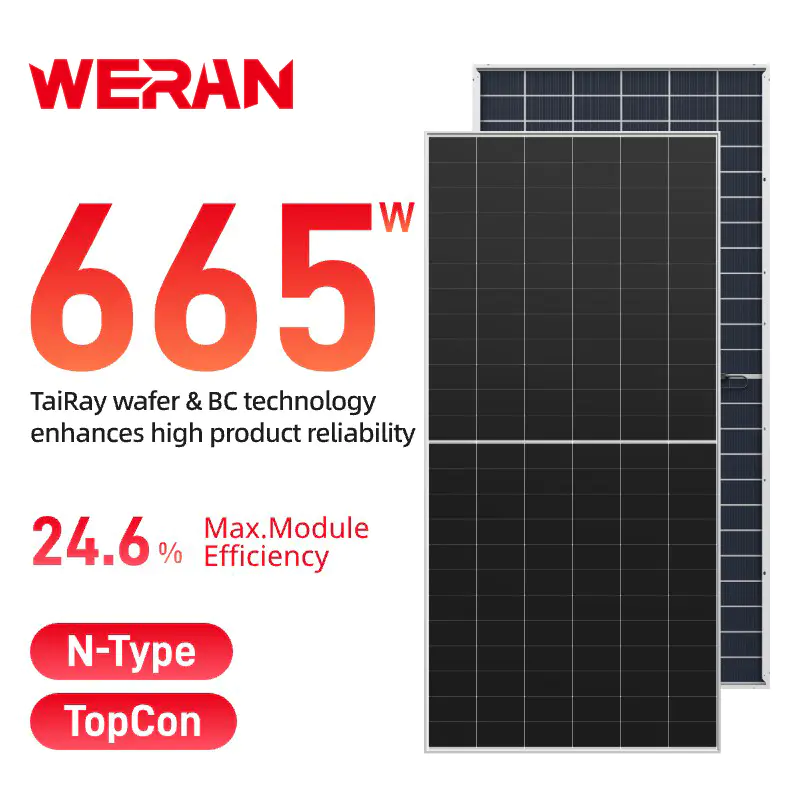
HPBC 2.0 Bifacial Solar Panel
665W
Wattage
23.6%
Max Module Efficiency
N-Type HPBC 2.0
01

Why Back Contact Design Reduces Shading and Resistive Losses

Efficiency gains in HPBC 2.0 come from two compounding effects. First, the absence of front busbars recovers light that would otherwise be reflected or absorbed by metal. Second, because contacts sit on the rear, they can be made wider and more numerous without sacrificing any front-side aperture, which lowers series resistance and reduces resistive power loss during current collection. Lower resistance also means the cell runs cooler under equivalent load, which further stabilizes output.

When benchmarked against mainstream cell technologies under standard test conditions, the efficiency gap becomes clear.

Module Efficiency by Cell Technology
P-type PERC 21.5% N-type TOPCon 22.8% HPBC 2.0 23.6%

An efficiency improvement of roughly one to two percentage points over TOPCon and PERC alternatives may look small in isolation, but across a 25 year service life on a fixed roof area, it compounds into a meaningfully larger total energy harvest, particularly on projects where roof space is the binding constraint rather than budget.

02

Thermal Behavior and Power Retention Under Heat Stress

Rooftop modules routinely operate well above the 25 degree Celsius rating condition used in datasheets, especially on dark composite shingles or low-slope commercial membranes where cell temperatures can climb past 55 or even 65 degrees Celsius during peak summer hours. Every silicon cell loses output as temperature rises, but the rate of loss, known as the temperature coefficient, varies by architecture.

The passivation layers used in HPBC 2.0 cells reduce recombination losses at elevated temperatures more effectively than standard back surface field designs, which flattens the output curve as heat increases.

Power Retention vs Cell Temperature
80 90 100 25C 35C 45C 55C 65C
HPBC 2.0 Standard BSF

The practical effect shows up most on hot climate installations and dark roofing materials, where a flatter thermal curve means the panel keeps delivering closer to its rated capacity precisely during the summer afternoon hours when electricity demand and grid pricing are typically highest.

03

Long-Term Degradation and Cumulative Energy Yield

Annual degradation rate determines how much of a panel's original output survives after two and a half decades of UV exposure, thermal cycling, and humidity ingress. Lower first-year degradation combined with a slower linear decline thereafter results in a meaningfully larger area under the energy production curve over the life of the system, even when starting efficiency is held constant.

Back-contact solar panels installed on a commercial roof
Cumulative Energy Yield Over 25 Years
Yr 5 Yr 10 Yr 15 Yr 25
HPBC 2.0 Standard PERC

Over a full 25 year contract or ownership period, the widening gap between standard PERC decline curves and HPBC 2.0 decline curves means the incremental energy advantage does not stay fixed at the first-year figure. It grows year over year, which is a critical variable for financial modeling on power purchase agreements and lease structures where revenue is tied directly to metered output.

04

Visual and Structural Advantages for Rooftop Integration

All-black HPBC 2.0 modules on a residential roof
Attribute Comparison
Efficiency Thermal Degradation Aesthetics Flexibility
HPBC 2.0 PERC

Because the front surface carries no visible busbars or grid lines, HPBC 2.0 modules present a uniform, all-black appearance that architects and homeowners increasingly specify for street-facing roof planes. This is not purely cosmetic on commercial projects either, since uniform panel color reduces glare inconsistency across large arrays and simplifies visual inspection during maintenance, as any hotspot or micro-crack tends to stand out more clearly against a clean background. Commercial property owners planning highly visible installations, such as showroom rooftops, hotel canopies, or mixed-use developments with rooftop terraces, often weigh visual consistency alongside kilowatt output when comparing supplier proposals.

05

From Wafer to Module: The HPBC 2.0 Manufacturing Flow

Producing a back-contact cell requires tighter process control than a standard front-contact line, since both polarity contacts must be precisely aligned on the same rear surface without shorting. The simplified sequence below outlines the core stages.

Manufacturing Process Flow
Wafer
Slicing
Doping and
Passivation
Rear Contact
Patterning
EL Testing
and Sorting
Lamination and
Framing

Electroluminescence testing after contact patterning is particularly important for back-contact designs, since micro-shorts between adjacent interdigitated fingers are not visible to the naked eye but can measurably affect fill factor. Suppliers with mature HPBC 2.0 lines typically run one hundred percent EL inspection rather than statistical sampling, which reduces the risk of early field failures reaching installed systems.

06

Comparing Total Cost of Ownership: Residential vs Commercial Deployment

Return on investment depends on more than panel price per watt. Installation labor, inverter sizing, roof area available, and long-term yield all factor into the final calculation. The table below summarizes how HPBC 2.0 characteristics typically influence project economics across the two most common deployment scenarios.

Factor Residential Rooftop Commercial Rooftop
Available roof area Often limited by roof shape Large but sometimes shading-affected
Value of higher efficiency High, since area is fixed High for area-constrained sites
Value of visual uniformity High for street-facing homes Moderate to high for visible facades
Sensitivity to thermal derating Moderate High on dark low-slope membranes
Impact of slower degradation Improves long-term savings Improves PPA and lease revenue

In both settings, the shared thread is that HPBC 2.0 economics improve most where the physical constraint is roof area rather than budget, and where the operating environment includes meaningful heat exposure. Sites without either constraint may see smaller relative gains, which is worth factoring into any project-specific payback calculation.

07

What to Evaluate When Choosing an HPBC 2.0 Solar Panel Supplier

Not every panel labeled as back-contact or N-type delivers the same real-world performance, since cell architecture, passivation quality, and encapsulation materials all vary by production line. Buyers researching an n-type hpbc module manufacturer should ask for third-party certified performance data rather than relying on datasheet claims alone, particularly around temperature coefficient and warranted degradation curves.

It is also worth reviewing how a supplier validates its back-contact solar panels before shipment, including electroluminescence pass rates, hot-spot testing under partial shading, and mechanical load testing for snow and wind conditions relevant to the installation region.

For commercial buyers evaluating high-efficiency solar solutions for commercial roofs, bankability documentation and consistent module-to-module output tolerance matter as much as the headline efficiency figure, since large arrays amplify the financial impact of any batch inconsistency. Finally, warranty structure deserves close reading: a meaningful performance warranty should specify guaranteed output at multiple points across the 25 year term rather than a single end-of-life figure.

08

Frequently Asked Questions

What makes HPBC 2.0 different from standard TOPCon panels?

HPBC 2.0 moves all electrical contacts to the rear of the cell, eliminating front-side shading and allowing a fully uniform light-absorbing surface, while TOPCon retains front-side grid lines despite also using N-type wafers.

Do back-contact panels require special inverters or wiring?

No. HPBC 2.0 modules are wired and connected the same way as standard panels and are compatible with common string and microinverter setups without additional equipment.

How does HPBC 2.0 perform in hot climates compared to standard panels?

Its passivation structure produces a flatter power retention curve as temperature rises, so output loss during peak summer heat is generally smaller than with conventional back surface field cells.

Are HPBC 2.0 panels a good fit for small residential roofs?

Yes. Their higher per-area efficiency is particularly valuable on roofs with limited usable space, since more energy can be generated without adding panel count.

What warranty terms should buyers expect from a reliable supplier?

Look for a linear performance warranty specifying guaranteed output at multiple intervals across 25 years, along with documented degradation testing rather than a single end-of-term figure.